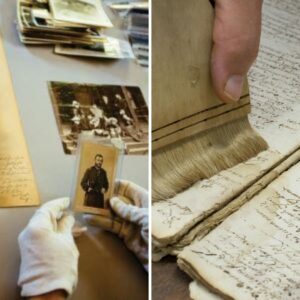
Discover, preserve and organise your family history — from genealogical research to the preservation of photographs and documents, and the management of digital archives.
Your family history is captured in old photographs, official and private documents, memoirs and digital files. Over time, without research, organisation and preservation, much of this heritage is lost.
As well as researching the past, it is also essential to ensure that it remains accessible to future generations.
Family history combines fields such as genealogy, heraldry, oral history and the preservation of photographs and physical and digital archives.
On this page, you will find practical courses to help you reconstruct, preserve and celebrate your family history.
What is Family History?
It is an interdisciplinary field that combines genealogy, oral history and cultural heritage with modern practices of archival conservation and organisation.
Today, studying family history involves not only researching origins and lineages, but also preserving old photographs, family albums and physical and digital archives, ensuring their transmission over time.
Oral history, for its part, through historical interviews, plays an essential role in preserving family memories that have not been recorded in written sources.
Areas of Family History
Genealogy
Genealogy allows us to reconstruct family history through parish, civil, institutional and private records, as well as other historical sources. It forms the basis for understanding family origins and connections.
Oral history enables the preservation of family memories through direct testimonies. The historical interview is the main tool for collecting these memories, allowing the recording of life stories, experiences and traditions that do not exist in written documents.
Old photographs, family albums and paper documents are, by their physical and chemical nature, fragile and require specific care to prevent their deterioration. Yet they are also a precious repository of memories and information about family and a primary historical source of great importance.
Preserving family history ensures that memories, identities and experiences are not lost over time, keeping the legacy alive for future generations.
Sometimes this is not easy to achieve, as information is often scattered across memoirs, documents and digital formats, frequently without any organisation or suitable conditions for preservation.
The most common problems
Deterioration of old photographs and documents
Poor storage of personal and family archives
Disorganised or lost digital files
Difficulty in starting genealogical research and preserving the data collected
Difficulty in collecting and recording information from living relatives
Our courses offer practical methods for:
Researching family history
Recording and organising the information gathered during genealogical research
Organising documents and photographs
Preserving physical and digital materials
Passing on the family legacy to future generations
Start preserving your family history today
Browse our courses and start building your family legacy today.
Do you have questions about how to start preserving your family history? Here we answer the most frequently asked questions.
FAQ – Frequently asked questions about preserving family history
Do I need any prior experience to take these courses?
No. The courses are designed for those with no prior knowledge of the subjects, but they are also suitable for those who already have some knowledge or work in related fields and wish to deepen their understanding of methods for researching, preserving and organising family history.
Are the courses suitable for any geographical context?
Yes, the courses present methodologies that are applicable in any geographical context. In particular, the Genealogy course is designed for cross-border research methods
Why is it so important to preserve old family documents and photographs?
Old documents and photographs are unique records of family history, containing information, faces and moments that cannot be recovered if they are lost. Preserving them keeps family memories alive, supports genealogical research and ensures that this historical and emotional heritage is passed on to future generations in good condition.
Are these courses only useful for personal use?
No. Although they are ideal for family projects, they can also be useful for professionals or students in the fields of heritage, history, genealogy, archiving and conservation.
Can I apply this knowledge straight away?
Yes. The courses take a practical approach, with clear guidance that allows you to start researching, organising and preserving your family history right away.
Do the courses include a certificate?
Yes, a certificate is issued for all courses and is included in the price.