
The Birth of Venus, by Sandro Botticelli, is one of the best-known, most admired and most frequently reproduced works in the history of art. A symbol of the Italian Renaissance, the painting captivates with the elegance of its figures, the richness of its symbolism and the way it draws on classical mythology.
In this article, we will explore the key details of this masterpiece, examining its historical context, the significance of its characters, its iconography and the elements that have made it an indispensable landmark of Western art.
- What The Birth of Venus represents – the myth
- The painting – composition and characters
- Botticelli’s unmistakable style
- The era and context in which it was created
- Who was Botticelli’s Venus?
- The depiction of Venus in art history
By: Rute Ferreira, author of the online courses: Art Curation | The Art Market

Source: Wikiart.org
Who is Sandro Botticelli’s Venus?
The girl born from a shell – Venus to the Romans and Aphrodite to the Greeks – has appeared everywhere in modern society, from packaging to notebook covers. She is the goddess of love and beauty, who, according to the most common version of Greek mythology, was born from sea foam and washed ashore on the coast of Cyprus, where she was raised by the Charites, daughters of Zeus.
The Birth of Venus: the myth
Mythology offers two versions of the goddess’s birth.
In the first, she appears as (yet another) daughter of Zeus and Dione, the goddess of the nymphs.
The second, more famous version, is linked to the Titans: when Cronus, son of Uranus, castrates his father, he casts his genitals into the sea. From there, Aphrodite is born, springing from the foam like a flower. The goddess is carried by Zephyr to Cyprus (and Zephyr, it is worth remembering, is the same gentle wind that carries Psyche to Eros’s palace).
Upon arriving in Cyprus, Aphrodite was taken in by the Seasons.
Later, she was brought before the other gods, who desired her as a wife, thanks to the magical girdle she wore. This belt, which appears in many works of art as a key element, caused everyone who saw her to fall in love with her.
The Birth of Venus: the painting
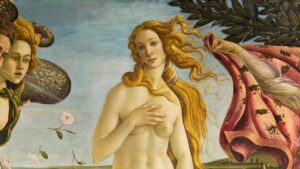
On the left, she is caressed by Zephyr, the god of the westerly winds, and on the right, she is presented with a blanket covered in flowers by one of the Hours, the goddesses of the seasons.

The Birth of Venus – Zephyr and Chloris

The Birth of Venus – Spring, one of the Hours
Although her body is facing the viewer, allowing him to contemplate her nudity – partially concealed by her hands and hair – she turns her face and gaze to her left.
The Birth of Venus by Sandro Botticelli – the time
It is believed that Sandro Botticelli produced this painting on commission from one of the Medici, who wanted it to adorn his home.
Created at a time when artistic production generally favoured Catholic themes, the work was seen as a kind of defence of paganism.
It was created during the Renaissance, a historical period spanning the 14th to the 16th centuries, when Italy was experiencing a culturally rich and intense era.

Sandro Botticelli’s unmistakable style
Although it is a work of undeniable aesthetic quality, certain details – such as the angle of Aphrodite’s shoulder – have been cited as flaws in Sandro Botticelli’s work.
In fact, these details – such as the elongation of the neck and the length of the arms – demonstrate the artist’s style, which was less realistic than that of his contemporaries, such as Raphael, for example.
Sandro Botticelli was also responsible for creating the painting *Venus and Mars* (that is, Aphrodite and Ares) in 1483, which depicts the god of war asleep whilst being watched by Aphrodite.
Although the goddess is the wife of Hephaestus, a one-legged god responsible for forging swords, Aphrodite maintains an ongoing affair with Ares. According to Martha Robles, “she is Ares’s natural companion, and their relationship confirms that fighting and loving are kindred passions”.

Sandro Botticelli, Venus and Mars, 1483.
The Birth of Venus by Sandro Botticelli reveals other aspects relating to its time and the context in which it was created, as we shall see below.


Understanding Greek Gods Iconography in Art

Guide to Florence – discover one of the world’s most fascinating destinations
Who was Sandro Botticelli’s Venus?
Despite all the cultural progress of the Renaissance it would have been scandalous for a woman to be depicted nude in a painting, but if she were depicted as a goddess, it would have been more acceptable.

In Sandro Botticelli’s paintings, Aphrodite is a slender woman with a delicate face and red hair that falls in waves.
It is highly likely that the model for the paintings was the young Simonetta Vespucci.
Regarded as one of the most beautiful women of her time, she is believed to have been the mistress of Giuliano de’ Medici, the youngest brother of the Medici family and one of Botticelli’s greatest patrons.
Although it cannot be determined with certainty in how many paintings Sandro Botticelli portrayed Simonetta, her face appears repeatedly in many of the artist’s works, even after the young woman’s death.

A victim of tuberculosis, the young woman died at the age of just 22, and it is said that she was so beautiful that her coffin was left open at the funeral simply so that she could be admired. She also appears in the painting Spring, once again as Venus.
Venus, the celebrated goddess of love
Aphrodite is one of the most celebrated goddesses in the history of art, although almost always under her Roman name.
This name has even been used to refer to prehistoric female figurines, such as the Venus of Willendorf, the Venus of Brassempouy and the Venus of Laussel.
Botticelli’s painting, however, is probably the most famous portrayal of the goddess, whose magic encompasses the mystery of transformation and the strongest of human emotions.
Frequently Asked Questions – The most important things to remember about The Birth of Venus
The Birth of Venus, by Sandro Botticelli, is one of the most iconic works of the Renaissance and one of the most visited paintings at the Uffizi Gallery in Florence. Its beauty is universally recognised, but its true value also lies in its symbolism, its inspiration from classical mythology and the influence it has had on the history of art.
In this section, we have compiled the most frequently asked questions about the painting and provided simple, straightforward answers to what is really important to know and remember about this masterpiece. If you are looking to quickly understand the meaning, history and significance of The Birth of Venus, these FAQs summarise the key points.
1. What does The Birth of Venus depict?
The painting depicts the birth of the goddess Venus, who emerges from the sea foam and reaches the shore in a shell. Inspired by classical mythology, it symbolises beauty, love and ideal perfection, making it one of the most iconic images of the Renaissance.
2. Why is The Birth of Venus one of the most famous paintings in the world?
Because it combines a harmonious composition, powerful symbolism and an idealised representation of human beauty. Furthermore, it is one of the greatest symbols of the Italian Renaissance and one of the most recognised works in the history of art.
3. Who painted The Birth of Venus?
The work was painted by Sandro Botticelli, one of the leading artists of the Florentine Renaissance, known for the elegance of his figures and his paintings inspired by classical antiquity.
4. Where is The Birth of Venus located?
The painting can be admired at the Uffizi Gallery in Florence, where it is one of the works most sought after by visitors to the museum.
5. Who are the figures depicted in the painting?
As well as Venus, the work depicts Zephyr and Aura (or Chloris), who are pushing the goddess towards the earth, and one of the Hours, goddess of the seasons, ready to cover her with a flower-strewn mantle. Each character has a symbolic meaning linked to nature, beauty and renewal.
6. What is the significance of the shell in which Venus is depicted?
The shell is an ancient symbol of birth, fertility and purity. In the painting, it reinforces the idea of the emergence of ideal beauty and Venus’s divine origin.
7. What is the significance of The Birth of Venus in the history of art?
The work represents the revival of themes from classical antiquity during the Renaissance and has become a symbol of Humanism, influencing generations of artists right up to the present day.
8. What message does Botticelli convey through this painting?
Rather than merely illustrating a classical myth, Botticelli presents an ideal of physical and spiritual beauty inspired by Neoplatonic thought, which was highly valued in fifteenth-century Florence.
9. What is most important to note when analysing The Birth of Venus?
It is essential to understand the symbolism of the figures, the influence of classical mythology, the delicacy of the lines, the elegance of the composition and the cultural context of the Renaissance. These elements explain why the work remains an indispensable landmark in the history of art.
10. How can one learn to interpret The Birth of Venus and other great works of art?
Understanding the historical context, iconography, symbolism and techniques of art analysis enables one to uncover meanings that go unnoticed upon superficial observation. Citaliarestauro’s courses dedicated to Art History and Art Analysis help to develop these skills, making visits to museums far more enriching.
More about Women and Mythology in the History of Art

Rute Ferreira
I am an art teacher with a background in theater, art history and museology. I’m also specialized in Distance Education and I work in basic education. I write regularly on the Citaliarestauro.com blog and the Dailyartmagazine.com. I firmly believe that the history of art is the true history of humanity.